
The Truth About Disordered Eating: Tools for Healing and Recovery
In this community talk, Mariah Sede explains what eating disorders really look like, what drives them, and how families and friends can help a loved one heal.
Your browser can't read aloud. Try Safari, Chrome or Edge.
 Featuring Mariah Sede, LPC (Idaho) · Pre-licensed (Oregon)
What counts as disordered eating?
People often picture strict diets, veganism, picky eating or the ultra-healthy person at the gym. Clinically, the DSM-5 describes an eating disorder as an ongoing disturbance in eating or eating-related behavior that harms a person's physical health or their emotional and social functioning.
A day in the life
To help the audience feel what it is like, Mariah tells the story of "Abby," a composite college freshman. Her day starts with an hour of exercise before breakfast, then constant planning, menu checking and calorie logging. She panics when her "safe" meal isn't available, skips plans with friends, and late at night, exhausted and starving, binges and then purges, promising herself it will be the last time. From the outside she looks fine. Inside, every day is anxiety, shame and exhaustion. That, Mariah says, is why she is so passionate about this work.
The six eating disorders in the DSM-5
- Pica: eating non-food substances
- Rumination disorder: repeatedly bringing food back up, which may be re-chewed, re-swallowed or spit out
- Avoidant/restrictive food intake disorder (ARFID): avoiding food so that energy or nutrition needs aren't met
- Anorexia nervosa: restriction leading to a very low body weight with an intense fear of gaining weight; one type includes binge eating and purging
- Bulimia nervosa: binge eating followed by behaviors to avoid weight gain, such as vomiting, laxatives, fasting or excessive exercise
- Binge eating disorder: eating unusually large amounts with a sense of lost control, often alone and followed by guilt or disgust
Hard facts
- Eating disorders have one of the highest mortality rates of any mental health condition.
- Because they are high-risk, many clinicians refer these clients out, which creates a barrier to care.
- Shame and fear of judgment keep many people from asking for help.
- Anorexia and bulimia are far more common in women, and bulimia most often begins in late adolescence or early adulthood.
What is underneath
Social media, peer pressure and popular culture shape body image, especially for young people who are still building a sense of worth. Underneath that is often a need for control: when life feels out of control, the body becomes the one thing a person can control. Going deeper, Mariah sees two common roots: enmeshment, a relationship so close that a young person can't think, decide or make mistakes for themselves, and trauma, which leaves people feeling powerless. Her message to parents is hopeful: if you have the power to hurt, you also have the power to heal, and that protective love can be turned toward empowering your child.
How you can help a loved one
- Remove shame. Approach with compassion, not judgment.
- Empathize. Step into their emotional experience.
- Empower. Focus on their strengths.
- See it as a coping mechanism. It is something they are doing to cope, not who they are, so they can learn to cope differently.
- Shift the paradigm. What started as a way to gain control is now controlling them; getting control back means recovering.
- Take baby steps in thinking, tolerating emotions and changing behavior. Too far, too fast sets people up to fail.
- Normalize setbacks. What matters is how you respond to a setback, not that it happened.
- Honor the authentic self. Draw out and respect their thoughts, feelings, values, preferences and boundaries, so they can grow into their own person.
Keep learning
- Eating disorder therapy in Salem-Keizer and by telehealth across Oregon
- Mariah on the Pre-Diet Podcast
- Meet Mariah Sede
- 10 ways to improve your mental health
- Free coping-skills worksheets
This summary is for general education and is not a substitute for professional care.
 Free guide
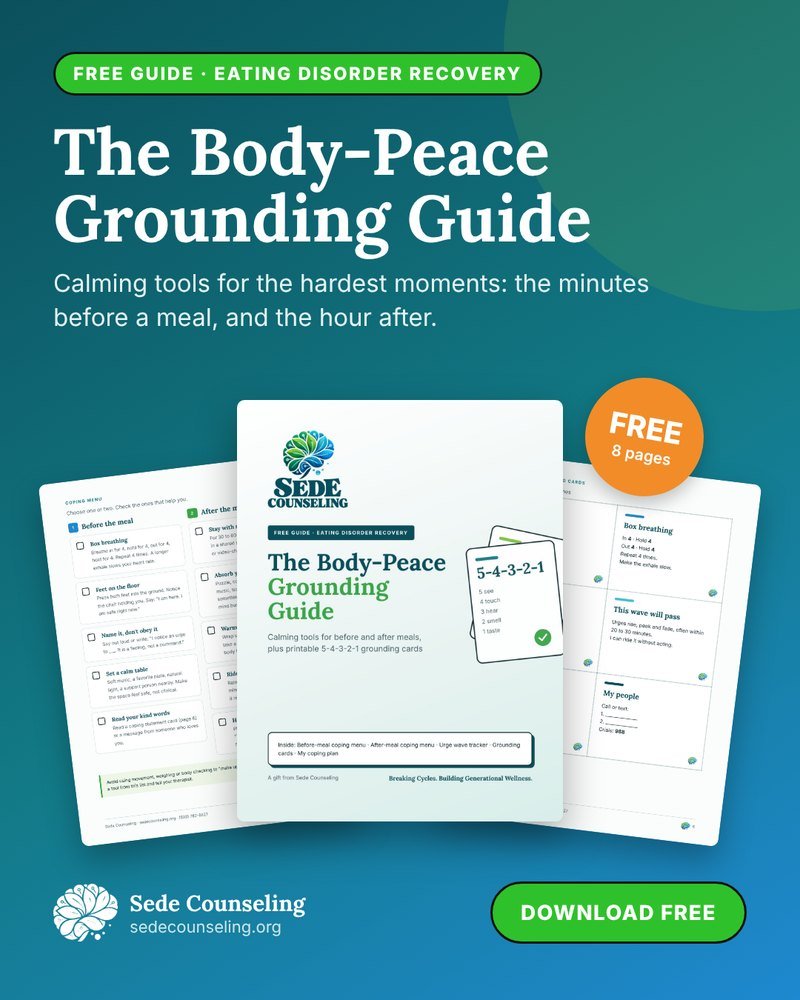
The Body-Peace Grounding Guide: eating disorder recovery tips
- A before-and-after-meals coping menu
- Printable 5-4-3-2-1 grounding cards
- Weekly recovery tips by email
No spam. Unsubscribe anytime. Tips are educational and do not replace therapy. Choose Español to get the guide and tips in Spanish.
Talk with our team. Your first 15-minute consultation is free.
Counseling in English and Spanish, in person in Keizer and by telehealth across Oregon. We will help you check your coverage.